When shopping for furniture, one of the most important — yet often overlooked — decisions is the material. You may find two pieces that look almost identical, but one is labeled solid wood, while the other is described as engineered wood.
So what’s the real difference of engineered wood vs solid wood?
Is solid wood always better?
Is engineered wood just a cheaper alternative?
Which one truly lasts longer?
If you’re investing in furniture for your home — especially major pieces like beds, dining tables, and dressers — understanding the difference can save you money, frustration, and future replacements.
Let’s break it down clearly and practically.
What Is Solid Wood?
Solid wood furniture is made entirely from natural lumber cut from trees. Each component — legs, panels, frames — is crafted from real wood planks.
Common solid wood types include:
- Oak
- Walnut
- Maple
- Ash
- Teak
- Pine
The defining feature of solid wood is its continuous grain structure. This natural fiber alignment gives it strength and durability.
Solid wood has been used in furniture construction for centuries — and many antique pieces made from solid hardwood still stand strong today.
What Is Engineered Wood?
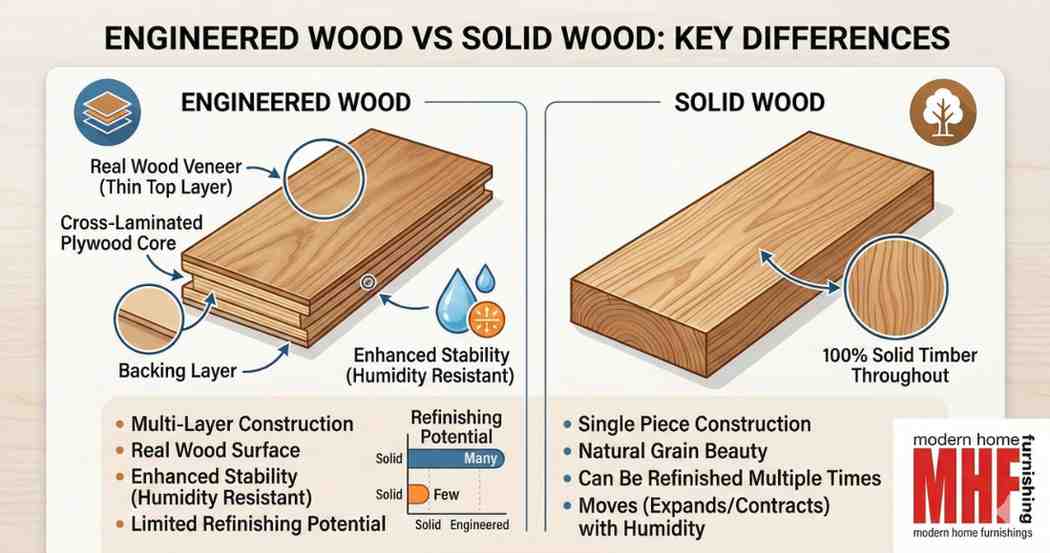
Engineered wood is a composite material made by bonding wood fibers, particles, or veneers together using adhesives and pressure.
Common types of engineered wood include:
- MDF (Medium Density Fiberboard)
- Particle board
- Plywood
- Veneer over core panels
Engineered wood was developed to:
- Reduce material costs
- Improve dimensional stability
- Make furniture more affordable
- Minimize natural wood waste
While engineered wood can look similar to solid wood, the internal structure is completely different.
Key Difference #1: Structure & Construction
The biggest difference of engineered wood vs solid wood lies in the internal composition.
Solid Wood Structure
✔ Natural grain fibers
✔ One continuous piece of lumber
✔ No synthetic bonding layers
✔ High internal strength
Engineered Wood Structure
✔ Compressed particles or layers
✔ Bonded with adhesives
✔ Manufactured sheets
✔ Strength depends on density and bonding
Because solid wood maintains its natural grain, it handles weight and stress more effectively.
Key Difference #2: Strength & Durability
Furniture is meant to be used daily. Beds support body weight. Dining tables hold heavy dishes. Dressers carry loaded drawers.
Solid Wood Durability
Solid wood is known for:
- High load-bearing capacity
- Resistance to sagging
- Long-term structural stability
- Decades of lifespan
With proper care, solid wood furniture can last 20–50 years or more.
Engineered Wood Durability
Engineered wood durability varies by type:
- Plywood: relatively strong
- MDF: dense but brittle
- Particle board: weaker under stress
Over time, engineered materials may:
- Loosen at screw joints
- Sag under heavy weight
- Chip at edges
- Weaken if exposed to moisture
For structural furniture like beds, solid wood typically lasts longer.
Key Difference #3: Lifespan
If you’re thinking long-term, lifespan matters.
Solid Wood Lifespan
✔ Often decades
✔ Can be refinished
✔ Repairable
✔ Maintains integrity over time
Engineered Wood Lifespan
✔ Typically 5–15 years
✔ Limited repair options
✔ Veneer damage is permanent
While engineered furniture may be affordable initially, it often requires replacement sooner.
Key Difference #4: Appearance & Natural Beauty
Solid wood offers something engineered materials cannot replicate fully: authentic grain character.
Solid Wood Appearance
✔ Unique grain patterns
✔ Natural texture
✔ Rich depth
✔ Ages beautifully
No two solid wood pieces are identical.
Engineered Wood Appearance
✔ Uniform finish
✔ Veneer mimics real grain
✔ Smooth painted surfaces
While modern veneers can look convincing, repeated patterns and artificial finishes are often noticeable over time.
Key Difference #5: Repair & Refinishing
Accidents happen — scratches, dents, or water marks.
Solid Wood
✔ Can be sanded
✔ Can be refinished
✔ Surface can be restored
✔ Color can be updated
Even after years of use, solid wood furniture can look brand new again.
Engineered Wood
❌ Cannot be deeply sanded
❌ Veneer cannot be restored easily
❌ Swelling from water is permanent
This makes solid wood more forgiving and longer lasting.
Key Difference #6: Moisture Resistance
Humidity plays a role in furniture longevity.
Solid Wood
- Expands and contracts naturally
- Requires proper care
- Performs well in controlled indoor climates
Engineered Wood
- More dimensionally stable
- Less reactive to minor humidity changes
- However, MDF and particle board swell permanently when wet
In regions like Vancouver and Surrey where indoor humidity varies, both materials require care — but solid wood maintains strength even with expansion.
Key Difference #7: Cost Comparison
One reason engineered wood is popular is price.
Solid Wood
- Higher upfront investment
- Longer lifespan
- Better long-term value
Engineered Wood
- Lower initial cost
- More budget-friendly
- Replacement may be needed sooner
If you replace an engineered bed every 8 years, it may cost more over time than buying one solid wood bed once.
Key Difference #8: Weight & Portability
Solid wood furniture is heavier.
This means:
✔ Stronger
✔ More stable
✔ Harder to move
Engineered wood furniture is:
✔ Lighter
✔ Easier to transport
✔ Simpler for frequent relocation
For renters or short-term living situations, engineered wood may be convenient.
Key Difference #9: Environmental Considerations
Solid wood:
- Renewable when responsibly sourced
- Minimal adhesives
- Biodegradable
Engineered wood:
- Uses wood waste efficiently
- Contains synthetic bonding agents
- May include formaldehyde-based adhesives
Sustainability depends on sourcing and manufacturing standards.
Which Is Better for Beds?
Beds require durability, joint strength, and long-term structural integrity.
Solid wood beds:
✔ Handle weight better
✔ Resist sagging
✔ Last decades
✔ Offer stronger joinery
Engineered wood beds:
✔ Lower upfront cost
✔ Suitable for short-term use
✔ May weaken at stress points over time
For something you use every night, strength matters.
Which Is Better for Dressers & Storage?
Drawer systems rely on stable frames.
Solid wood:
✔ Better drawer alignment
✔ Less sagging
✔ Stronger supports
Engineered wood:
✔ Affordable
✔ Works for light use
For high-traffic bedrooms, solid wood typically performs better.
When Engineered Wood Makes Sense
Engineered wood can be a smart choice when:
✔ Budget is limited
✔ Furniture is temporary
✔ Student housing setup
✔ Rental properties
✔ Lightweight movement needed
It provides accessibility and affordability.
When Solid Wood Is Worth the Investment
Solid wood is ideal when:
✔ Furnishing a primary home
✔ Planning long-term use
✔ Seeking durability
✔ Wanting refinishing flexibility
✔ Valuing natural materials
If longevity and structural reliability matter most, solid wood is usually the better choice.
The Final Difference Of Engineered Wood Vs Solid Wood
The true difference comes down to:
Durability.
Longevity.
Repairability.
Investment value.
Engineered wood offers affordability and stability.
Solid wood offers strength, lifespan, and timeless appeal.
Neither material is “bad” — but they serve different purposes.
If you’re furnishing a forever home and want furniture that truly lasts, solid wood often proves to be the stronger long-term investment.
If your priority is short-term affordability and flexibility, engineered wood can serve its purpose.
Understanding the difference empowers you to choose wisely — not just based on price, but based on how long you want your furniture to last.