
When investing in a new bed, most homeowners focus on design, size, and price. But the real factor that determines whether your bed will last five years or fifty is something far more important: the material.
The debate between solid wood vs engineered wood beds is more relevant than ever. With modern manufacturing making engineered furniture widely available, many buyers wonder whether solid wood is still worth the investment.
If you’re searching for the bed that truly lasts, this comprehensive guide will help you understand:
- The structural differences between solid wood and engineered wood
- Why durability matters in bed construction
- Long-term cost comparisons
- Which option performs better in Vancouver homes
- When engineered wood may still make sense
Let’s begin with the fundamentals.
What Is a Solid Wood Bed?
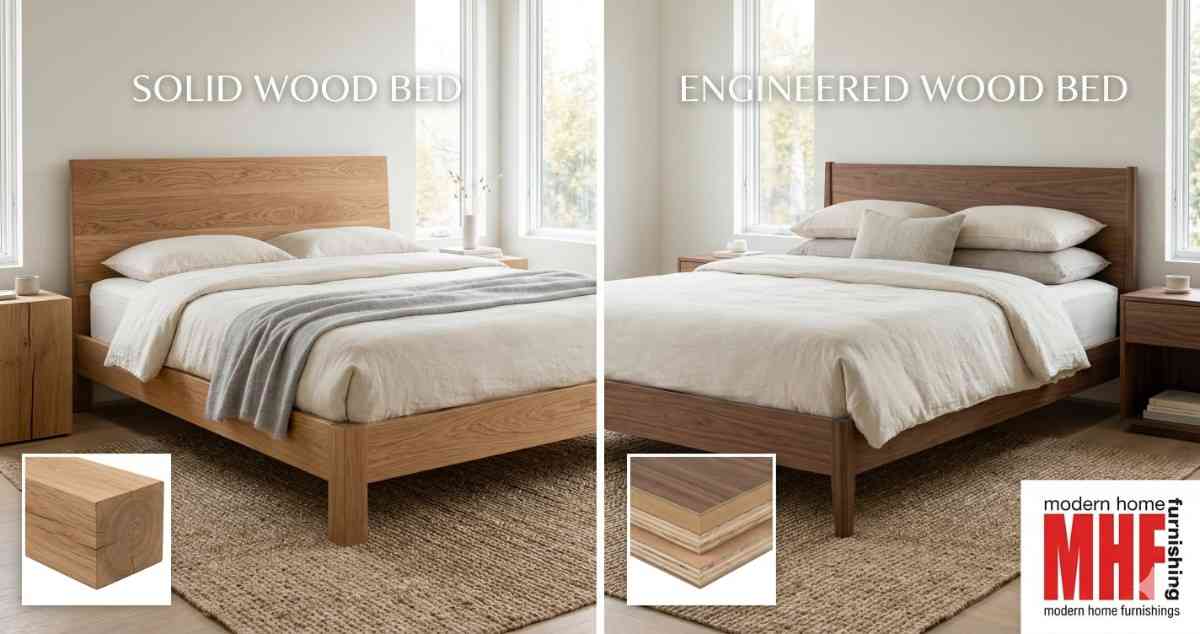
A solid wood bed is constructed entirely from natural lumber such as oak, maple, walnut, ash, or other hardwoods. These beds maintain the natural grain and structural integrity of the tree.
Because the wood fibers run continuously through each plank, solid wood offers exceptional strength and stability.
Solid wood has been used in bed construction for centuries — not because it’s trendy, but because it works.
What Is an Engineered Wood Bed?
Engineered wood beds are made from composite materials such as:
- MDF (Medium Density Fiberboard)
- Particle board
- Plywood cores
- Veneer-over-board panels
These materials are manufactured by compressing wood fibers or layering veneers with adhesives.
While engineered wood can replicate the look of solid wood, the internal structure is significantly different.
If you’d like a deeper comparison of these materials, this guide breaks it down thoroughly:
👉 https://modernhomefurnishings.ca/2026/02/22/the-pros-and-cons-of-solid-wood-vs-engineered-wood/
Now let’s focus specifically on beds — where durability matters most.
Why Beds Demand Stronger Materials
Beds are not decorative furniture. They are structural.
A bed frame must support:
- Mattress weight
- Body weight
- Nightly movement
- Sitting pressure on edges
- Occasional jumping (especially in family homes)
Unlike a bookshelf or console table, a bed experiences consistent, repetitive stress.
That’s where material choice becomes critical.
1. Structural Strength: Solid Wood Leads
Solid wood beds are stronger because they maintain continuous grain fibers throughout the frame.
This means:
✔ Better weight distribution
✔ Less sagging over time
✔ Higher load capacity
✔ More reliable slat support
Engineered wood, especially MDF and particle board, relies on compressed particles and adhesives. Over time, stress can weaken these bonds.
For queen and king beds — especially storage designs — solid wood offers a clear structural advantage.
2. Joint Integrity: Where Engineered Beds Often Fail
Bed durability isn’t just about planks — it’s about joints.
Solid wood beds typically use:
- Mortise-and-tenon joints
- Reinforced corner blocks
- Dowels and heavy-duty brackets
These joinery methods distribute weight evenly and resist loosening.
Engineered wood beds often depend on:
- Cam locks
- Screws into compressed board
- Lightweight metal connectors
Repeated stress can cause screw holes in engineered boards to widen, leading to instability.
Once that happens, repairs are rarely permanent.
3. Longevity: Decades vs. Years
One of the most compelling reasons to choose solid wood is lifespan.
A high-quality solid wood bed can last:
- 20–50 years
- Potentially multiple generations
Engineered wood beds often show wear within:
- 5–10 years under daily use
When calculating long-term cost, replacing a cheaper bed twice may exceed the price of investing in one durable solid wood frame.
The bed that truly lasts isn’t the cheapest — it’s the strongest.
4. Repairability & Refinishing
Life happens. Scratches and dents are inevitable.
Solid wood offers flexibility:
✔ Sanding
✔ Refinishing
✔ Restaining
✔ Surface restoration
Even deeper damage can often be repaired.
Engineered wood veneer, however, cannot be sanded deeply. Once the veneer layer chips, the underlying material is exposed.
This limits long-term restoration options.
To protect your investment properly, proper maintenance matters. Here’s how to care for solid wood bedroom furniture:
👉 https://modernhomefurnishings.ca/2023/03/26/how-to-care-for-solid-wood-bedroom-furniture/
5. Stability in Vancouver’s Climate
Vancouver and Surrey homes experience moderate humidity fluctuations.
Solid wood naturally expands and contracts with climate changes — but maintains strength.
Engineered wood may resist expansion better, but this stability doesn’t equal durability.
For high-stress furniture like beds, structural integrity outweighs minor climate stability differences.
6. Storage Beds: Strength Matters Even More
Storage beds are increasingly popular in urban homes where space is limited.
These beds include:
- Drawer systems
- Lift-up mechanisms
- Reinforced bases
Solid wood frames better support these moving components.
Engineered storage beds are more prone to:
- Drawer misalignment
- Hardware loosening
- Frame shifting
For multi-functional furniture, solid wood provides longer-term reliability.
7. Aesthetic Aging & Timeless Appeal
Solid wood develops character over time. Grain deepens, tones warm, and minor imperfections blend naturally.
Engineered veneer may look polished at first, but surface damage becomes more noticeable.
Solid wood beds age gracefully.
Engineered beds often show age abruptly.
8. Environmental & Health Considerations
Solid wood contains minimal synthetic adhesives compared to MDF or particle board.
For homeowners prioritizing natural materials in the bedroom — where you spend one-third of your life — this can be an important factor.
9. Resale & Investment Value
Solid wood beds retain value.
Engineered wood beds typically depreciate quickly.
If you consider furniture a long-term investment rather than disposable décor, material quality matters.
If you’re exploring where to invest in long-lasting solid wood furniture, this guide offers helpful insights:
👉 https://modernhomefurnishings.ca/2024/03/02/discover-quality-and-your-destination-for-solid-wood-furniture/
When Engineered Wood Beds Make Sense
To be fair, engineered wood beds can work well when:
✔ Budget is extremely tight
✔ The bed is temporary
✔ Furnishing student housing
✔ Rental property staging
They provide accessibility and affordability.
But understanding their limitations is important.
When Solid Wood Is the Smarter Choice
Choose solid wood when:
✔ Furnishing your primary bedroom
✔ Seeking long-term durability
✔ Wanting repair flexibility
✔ Prioritizing structural integrity
✔ Looking for better resale value
The bed you sleep on every night should be built to last.
Cost Comparison: Short-Term vs Long-Term Thinking
Upfront cost:
- Engineered wood: Lower
- Solid wood: Higher
Long-term cost:
- Engineered wood: Replacement cycle likely
- Solid wood: One-time investment
Over decades, solid wood often proves more economical.
Final Verdict: The Bed That Truly Lasts
When comparing solid wood vs engineered wood, the answer becomes clear in long-term use.
Solid wood beds offer:
✔ Superior strength
✔ Longer lifespan
✔ Repairability
✔ Structural integrity
✔ Timeless appearance
✔ Better long-term value
Engineered wood beds offer:
✔ Lower upfront cost
✔ Lightweight convenience
✔ Acceptable short-term performance
But if you’re looking for the bed that truly lasts, solid wood consistently outperforms engineered options.
A bed isn’t just furniture — it’s the foundation of your comfort, sleep quality, and daily routine.
Choose durability.
Choose strength.
Choose long-term value.