
Is MDF Strong? Pros, Cons & Best Uses Explained Guide
By Shubham Bhattacharjee · 2/22/2026
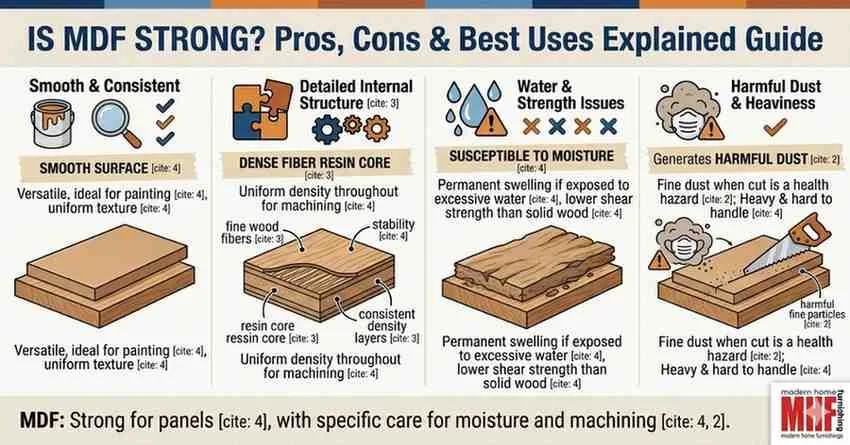
If you’ve been shopping for furniture recently, you’ve likely seen the term MDF (Medium Density Fiberboard) in product descriptions. And naturally, one of the first questions that comes to mind is:
Is MDF strong?
The answer isn’t simply yes or no.
MDF can be strong in certain applications — but not in the same way solid wood is strong. Understanding where MDF performs well and where it falls short can help you make smarter furniture decisions, especially for high-use pieces like beds, dressers, and storage units.
In this detailed guide, we’ll explain:
- What MDF actually is
- How strong MDF really is
- The pros of MDF
- The cons of MDF
- When MDF works best
- When solid wood is the better option
Let’s start with the basics.
What Is MDF?
MDF stands for Medium Density Fiberboard. It’s an engineered wood product created by:
- Breaking down hardwood or softwood into fine fibers
- Mixing those fibers with wax and resin adhesives
- Compressing them under high heat and pressure
- Forming dense, smooth panels
Unlike solid wood, MDF does not have visible grain patterns or natural knots. It is uniform throughout.
Because of its smooth finish and consistent density, MDF is widely used in:
- Painted furniture
- Cabinet doors
- Shelving units
- Dressers
- Decorative panels
Now let’s answer the main question.
Is MDF Strong?
MDF is dense and stable, but it is not as structurally strong as solid hardwood.
It performs well in:
✔ Decorative applications
✔ Painted surfaces
✔ Low to moderate weight furniture
✔ Interior cabinetry
However, MDF is less strong when:
❌ Supporting heavy loads
❌ Bearing structural stress
❌ Holding screws repeatedly under tension
❌ Exposed to moisture
So the real answer is:
MDF is strong for certain uses — but not for all furniture applications.
Understanding MDF Strength: What Makes It Different?
The strength of any material depends on its internal structure.
Solid Wood Structure
- Continuous natural grain fibers
- Strong internal fiber alignment
- High weight-bearing capacity
MDF Structure
- Compressed wood fibers
- No natural grain reinforcement
- Strength relies on density and adhesives
Because MDF lacks natural grain direction, it doesn’t distribute weight the same way solid wood does.
That’s why MDF can feel heavy — but still be weaker in structural performance.
Pros of MDF
Let’s explore where MDF truly shines.
1. Smooth, Uniform Surface
One of MDF’s biggest strengths is its smooth surface.
It has:
✔ No knots
✔ No grain patterns
✔ No texture variations
This makes MDF ideal for:
- Painted furniture
- Modern minimalist styles
- Cabinet doors
- Contemporary dressers
If you want a sleek, clean look, MDF performs beautifully.
2. Affordable Price Point
MDF furniture is generally more budget-friendly than solid wood furniture.
Because it uses wood fibers instead of full lumber planks, manufacturing costs are lower.
This makes MDF appealing for:
✔ First-time homeowners
✔ Students
✔ Rental properties
✔ Temporary living situations
If budget is your top priority, MDF offers accessible options.
3. Dimensional Stability
Unlike solid wood, MDF does not expand and contract significantly with minor humidity changes.
It remains:
✔ Flat
✔ Uniform
✔ Less prone to warping
This makes it useful for cabinet panels and painted furniture components.
4. Easy to Shape & Machine
MDF is easier to cut and shape than hardwood.
It can be:
✔ Routed
✔ Grooved
✔ Carved
✔ Molded
This flexibility allows manufacturers to create intricate panel designs.
Cons of MDF
Now let’s look at where MDF struggles.
1. Lower Structural Strength
While MDF is dense, it does not have the same internal reinforcement as solid wood.
Under heavy stress, MDF can:
❌ Sag
❌ Crack
❌ Weaken at screw joints
❌ Lose grip around hardware
For high-stress furniture like beds or heavy dining tables, this can become a problem over time.
2. Moisture Sensitivity
One of MDF’s biggest weaknesses is water exposure.
If MDF becomes wet:
- It swells
- It softens
- It loses structural integrity
- The damage is often permanent
Unlike solid wood, MDF cannot easily recover from water damage.
This makes it less ideal for damp environments.
3. Difficult to Repair
Solid wood furniture can be sanded and refinished.
MDF cannot be deeply sanded without exposing compressed fibers underneath.
Once damaged:
❌ Veneer chips are permanent
❌ Surface dents are difficult to fix
❌ Water swelling cannot be reversed
This limits long-term restoration.
4. Screw Holding Limitations
MDF does not hold screws as strongly as solid wood.
Repeated tightening can cause:
- Stripped screw holes
- Loose joints
- Wobbling structures
For furniture that is assembled and disassembled multiple times, MDF may weaken faster.
Is MDF Strong Enough for Beds?
Beds require:
- High weight capacity
- Structural integrity
- Resistance to movement
- Long-term durability
MDF may be used for:
✔ Decorative headboards
✔ Panels
✔ Non-load-bearing components
But for full structural bed frames, solid wood typically provides stronger long-term performance.
If you plan to use a bed daily for years, durability matters.
Is MDF Strong Enough for Dressers?
MDF dressers can work well if:
✔ Drawer loads are moderate
✔ Hardware is installed properly
✔ The piece isn’t exposed to moisture
However, heavy drawer use may weaken screw points over time.
For long-term durability, many homeowners prefer solid wood drawer boxes and frames.
MDF vs Solid Wood: Strength Comparison
| Feature | MDF | Solid Wood |
|---|---|---|
| Density | High | Moderate to High |
| Load Capacity | Moderate | High |
| Screw Holding | Moderate | Strong |
| Moisture Resistance | Low | Moderate |
| Repairability | Limited | High |
| Lifespan | 5–10 years | 20–50 years |
Solid wood remains stronger overall — especially for structural furniture.
Best Uses for MDF
MDF works best for:
✔ Painted cabinet doors
✔ Decorative panels
✔ Shelving for light use
✔ Accent furniture
✔ TV stands (moderate load)
✔ Modern lacquer finishes
It is less suitable for:
❌ Heavy bed frames
❌ Large dining tables
❌ High-load storage systems
❌ Moisture-prone environments
When Should You Avoid MDF?
Consider avoiding MDF if:
✔ You want furniture that lasts decades
✔ The piece will carry heavy weight daily
✔ You want refinishing flexibility
✔ You prioritize long-term durability
✔ You live in a humid environment
In those cases, solid wood often proves more reliable.
Is MDF Worth It?
Yes — when expectations align with its purpose.
If you’re furnishing:
- A rental unit
- A student apartment
- A temporary home
- A budget-conscious space
MDF can be practical and cost-effective.
But if you’re furnishing a long-term residence and investing in core furniture pieces, solid wood may offer better long-term value.
Long-Term Cost Perspective
Short-term:
MDF costs less upfront.
Long-term:
Replacing MDF furniture every 7–8 years may cost more than investing in solid wood once.
Understanding lifespan helps guide the right choice.
Final Verdict: Is MDF Strong?
MDF is strong enough for many decorative and moderate-use furniture pieces.
But it is not as structurally strong or long-lasting as solid wood.
MDF Strengths:
✔ Affordable
✔ Smooth finish
✔ Stable in minor humidity shifts
✔ Easy to shape
MDF Weaknesses:
❌ Lower load-bearing capacity
❌ Moisture vulnerability
❌ Limited repair options
❌ Shorter lifespan
If you understand its limitations and use it appropriately, MDF can serve its purpose well.
But for high-use, high-stress furniture like beds and heavy storage — strength truly matters.
Choosing the right material isn’t about trends. It’s about matching furniture to your lifestyle, timeline, and expectations.